Integrated BIM, MEPF & VDC Engineering
MEP • BIM • VDC • MULTIDISCIPLINE COORDINATION

MEP Clash Detection & BIM Coordination Services

Identify, classify, coordinate and track multidisciplinary BIM issues before they become construction conflicts — connecting mechanical, electrical, plumbing, fire protection, structure and architecture in one controlled review workflow.

Federated Models Hard Clashes Clearance Review Issue Tracking Constructability Clash Closure
Federate Multidiscipline Models
Detect Potential Conflicts
Resolve Coordination Issues
Verify Issue Closure
Model Coordination

Finding a Clash Is Only the Beginning

Clash-detection software can identify potential geometric conflicts between models.

But a coordination workflow must determine whether the clash is relevant, who owns the issue, what design or routing decision is required and whether the revised condition has actually been resolved.

Effective coordination is therefore an issue-management process — not simply a clash report.
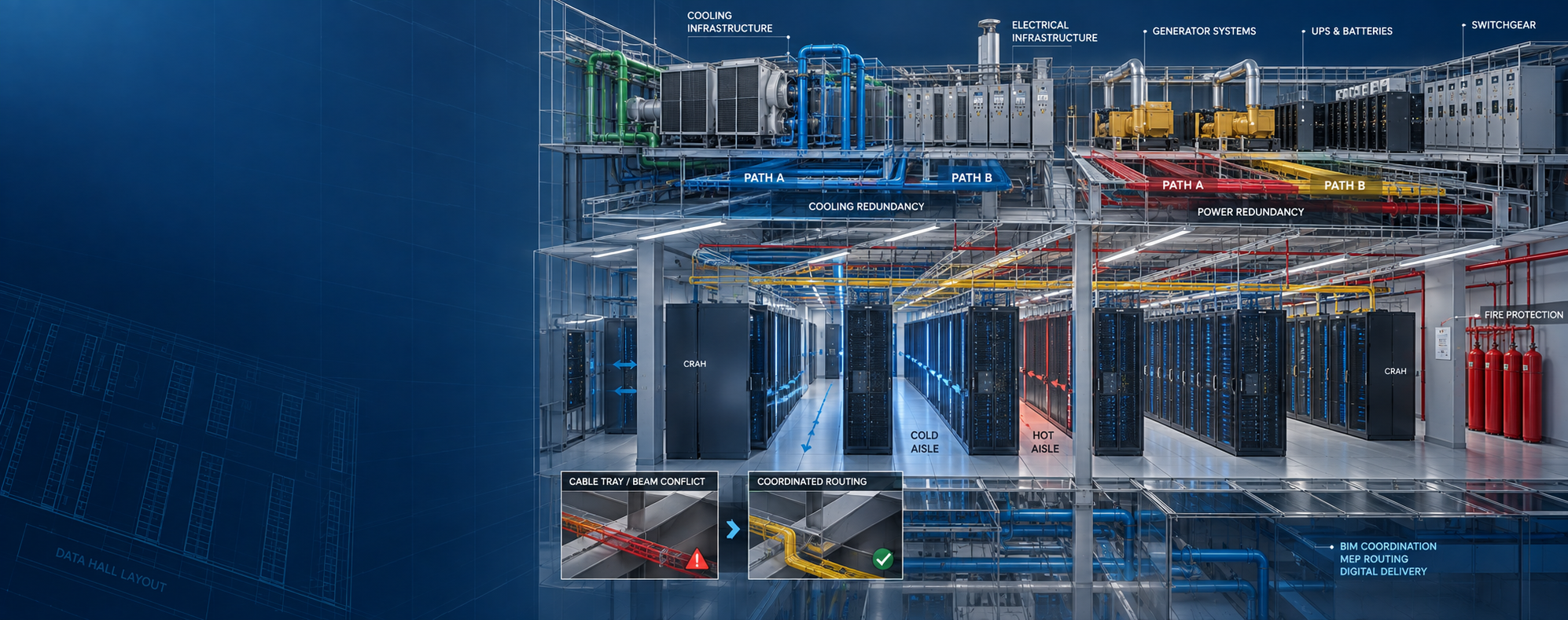
MEP BIM clash detection and multidisciplinary coordination
Federated Model Coordination Mechanical • Electrical • Plumbing • Fire Protection • Structure • Architecture
Clash Classification

Not Every Coordination Issue Is the Same Type of Clash

Clash tests should be structured around the project systems, required clearances and coordination objectives.

01 / HARD CLASH

Physical Intersections

Two modeled elements occupy the same physical space, such as ductwork intersecting structure or piping crossing another service.

02 / CLEARANCE

Soft / Clearance Clashes

Elements may not physically intersect but may violate required access, maintenance or service-clearance zones.

03 / WORKFLOW

Constructability Issues

Model geometry may technically fit while creating an impractical installation, access or sequencing condition.

Coordination Capabilities

From Model Federation to Coordination Closure

01 / FEDERATION

Federated Model Assembly

Discipline models brought together within a common coordination environment.

02 / TESTING

Clash Test Setup

Clash tests structured around relevant trades, systems and coordination priorities.

03 / CLASSIFICATION

Clash Review & Classification

Potential clashes reviewed to separate meaningful coordination issues from irrelevant model intersections.

04 / PRIORITY

Issue Prioritization

Issues grouped by trade, location, impact and project-defined priority.

05 / ASSIGNMENT

Coordination Issue Tracking

Issues organized for assignment, review and resolution tracking.

06 / REVIEW

Constructability Review

Routing and access considered in relation to installation and construction constraints.

07 / COORDINATION

Trade Coordination Support

Project information organized to support multidisciplinary coordination discussions.

08 / RECHECK

Clash Re-Run

Revised models reviewed against the agreed clash rules after updates.

09 / CLOSURE

Coordination Closure Review

Issue status reviewed before coordinated model information proceeds to the next project stage.

Coordination Control

Zero Reported Clashes Does Not Automatically Mean the Model Is Coordinated

Clash results depend on what models were included, how current those models are, which rules were tested and what tolerances were applied.

A meaningful coordination process therefore needs model control, issue traceability and closure verification.

Model Version Matters Clash results are meaningful only when the intended model versions are being reviewed.
Test Rules Matter Different system combinations and tolerances can produce very different clash results.
Status Needs Evidence An issue marked resolved should be confirmed against the updated model condition.
Constructability Extends Beyond Clashes Installation access, maintenance zones and sequence constraints may require separate review.
Coordination Workflow

A Controlled Clash Detection Process

01

Receive Models

Collect required discipline models and project references.

02

Federate

Combine models within the agreed coordination environment.

03

Run Tests

Execute project-defined clash and clearance rules.

04

Classify

Review, group and prioritize relevant coordination issues.

05

Resolve

Incorporate approved coordination decisions into discipline models.

06

Verify

Re-run tests and confirm issue status.

Issue Lifecycle

A Clash Should Have a Visible Path to Closure

Coordination becomes easier to control when every relevant issue has a clear status and responsible workflow.

STATUS 01 Identified Potential coordination issue detected in the federated model.
STATUS 02 Under Review Clash context and responsibility being evaluated.
STATUS 03 Assigned Issue routed to the appropriate discipline or project participant.
STATUS 04 Resolution Proposed Routing or model adjustment prepared for project review.
STATUS 05 Model Updated Approved coordination change incorporated into the discipline information.
STATUS 06 Re-Tested Updated model condition checked against coordination rules.
STATUS 07 Verified Coordination condition confirmed against the updated model.
STATUS 08 Closed Issue completed within the agreed coordination workflow.
Coordination Interfaces

MEP Coordination Across Connected Building Systems

HVAC vs Structure Duct routing, beams, slabs, framing and openings.
Plumbing vs Structure Drainage routes, penetrations, slopes and structural constraints.
Electrical vs MEP Containment, equipment, services and access zones.
Fire Protection vs MEP Sprinklers, pipework and ceiling/service coordination.
MEP vs Architecture Ceilings, walls, shafts and room geometry.
MEP vs Equipment Connection points, service access and maintenance clearances.
MEP vs Openings Sleeves, penetrations and coordinated builder's-work requirements.
MEP vs MEP Service crossings, elevation conflicts and routing priorities.
Coordination Deliverables

Typical Outputs from Clash Detection & Coordination

Federated Coordination Model

Multidiscipline model environment assembled for coordinated review.

Clash Reports

Organized coordination issues based on agreed clash tests and project review requirements.

Issue Tracking Information

Structured issue status, assignment and review information.

Coordination Views

Model snapshots and project views supporting issue discussions.

Revised Coordination Models

Updated discipline information reflecting approved coordination decisions.

Closure Review

Re-tested coordination status after model updates.

Project Information

What Goes Into the Coordination Workflow

Typical Inputs

  • Architectural BIM models
  • Structural BIM models
  • Mechanical models
  • Electrical models
  • Plumbing models
  • Fire-protection models
  • Design drawings / specifications
  • Project coordination requirements

Typical Coordination Outputs

  • Federated model
  • Clash-test results
  • Classified coordination issues
  • Issue snapshots / viewpoints
  • Discipline coordination updates
  • Re-tested clash results
  • Coordination-status information
  • Updated coordinated models
Coordination QA

Clash Detection Needs Controlled Model Inputs

Reliable clash review depends on more than running software tests.

Model versions, coordinates, discipline completeness, tolerance rules and issue status all affect the result.

Model Version Confirm the intended model revision is used.
Coordinates Check model alignment within the coordination environment.
Clash Rules Confirm system combinations and required tolerances.
False Positives Review results before treating every intersection as a project issue.
Issue Status Maintain clear coordination-state visibility.
Closure Verification Confirm resolved issues against updated models.
Project Applications

Coordination for Complex Building Environments

Data Centers Dense power, cooling and technical infrastructure coordination.
Healthcare Highly coordinated building-service environments with constrained technical spaces.
Commercial Buildings Multidiscipline coordination for offices, mixed use and corporate environments.
Industrial Facilities Process, utilities and technical-building coordination.
Life Sciences Technical service coordination in laboratory and controlled environments.
Semiconductor & High-Tech High-density utilities and technically constrained facility coordination.
Coordination Responsibility

Coordination Does Not Replace Engineering Authority

Coordination can identify project conflicts and support routing decisions.

Design changes, engineering calculations, system performance, code compliance and professional approvals remain subject to the responsible project disciplines and agreed contractual scope.

Identify Surface potential multidisciplinary coordination issues.
Communicate Provide clear model context for project review.
Incorporate Apply approved project coordination decisions.
Verify Recheck updated conditions before issue closure.
Frequently Asked Questions

MEP Clash Detection FAQs

Which disciplines can be included in clash detection?

Depending on project scope, coordination can include mechanical, electrical, plumbing, fire protection, structural and architectural models.

What is a hard clash?

A hard clash occurs when modeled physical elements occupy overlapping space, such as ductwork intersecting structural framing.

What is a clearance or soft clash?

A clearance issue occurs when elements do not physically intersect but violate a required access, maintenance or project-defined clearance zone.

Is clash detection the same as BIM coordination?

No. Clash detection identifies potential conflicts. BIM coordination includes review, classification, assignment, approved resolution, model updates and closure verification.

Does a clash-free model mean it is ready for construction?

Not automatically. Model completeness, constructability, maintenance access, unresolved design information and project approvals may still require review.

Can revised models be rechecked after coordination changes?

Yes. Revised discipline models can be federated again and clash tests re-run to review issue status.

BIM Coordination Review

Need MEP Clash Detection or Model Coordination Support?

Share your discipline models, project stage, coordination requirements and expected issue-management or model-delivery workflow.

Send Project Details WhatsApp Us
WA Discuss Your Project